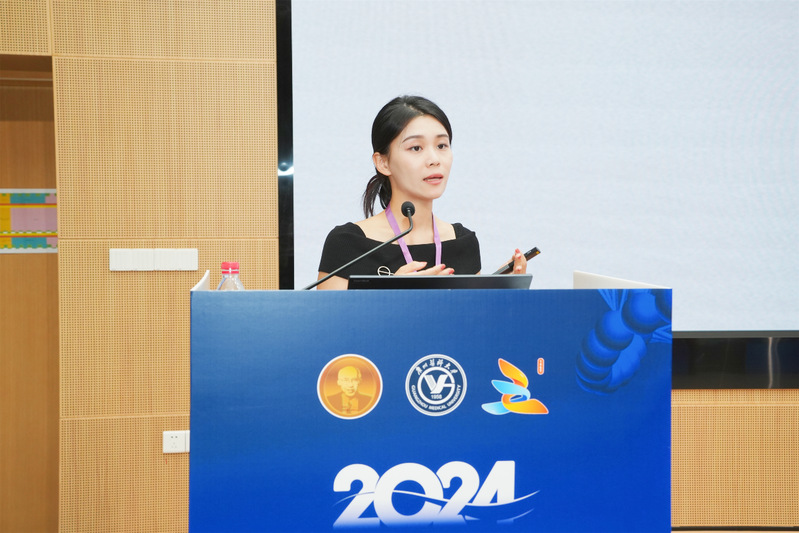
On October 25th, the Ray Wu Prize Award Ceremony was held at Guangzhou Medical University, concurrently with the 13th Ray Wu Memorial Symposium. Xiaoying Zhang, PhD candidate of the School of Life Science and Technology, Tongji University, won this honor.
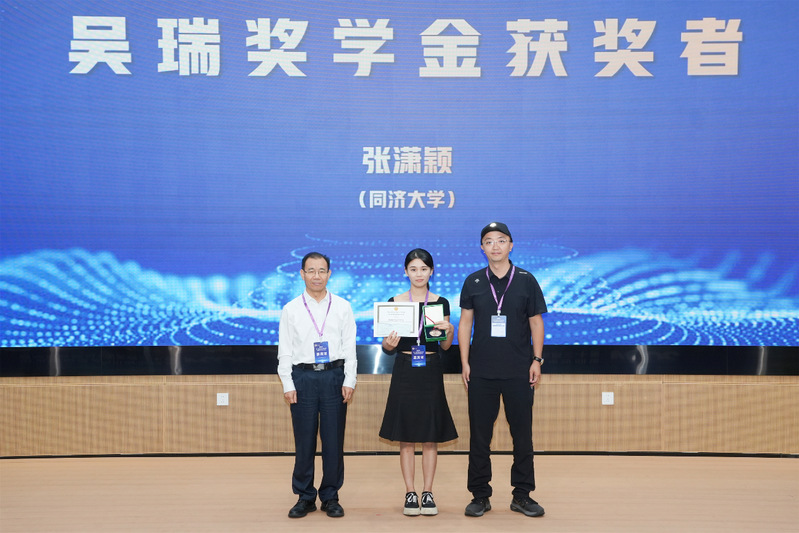
The Ray Wu Prize, established in honor of Dr. Ray Wu, a true scholar in the world and a strong advocate for life sciences throughout Asia, and his significant contributions to the development of life sciences in China, is recognized as the highest award for doctoral students in biomedical sciences of Chinese descent. The Ray Wu Prize, established in 2009, recognizes excellence in life science research by a graduate student for innovation, independent thinking, and dedication, aiming to inspire Asia’ s most promising young Ph.D. students to become future leaders in life sciences. The Ray Wu Prize is awarded each year to graduate students who are pursuing a degree of Doctor of Philosophy (Ph. D.) in an academic institution located in mainland China, Hong Kong, Taiwan, or Singapore. Since its inception in 2009, the Wu Rui Scholarship has been awarded to more than 150 individuals, many of whom have become top talents in life science research in China.
Under the guidance of Dr. Rui Yue, Xiaoying Zhang focused on the regulation of the hematopoietic stem cell (HSC) microenvironment by biomechanical factors and innovatively reversed HSC aging by reconstructing a soft bone marrow microenvironment in vitro. Her series of high-quality research achievements earned unanimous praise from the Ray Wu Memorial Fund Committee, ultimately winning her the 2024 Ray Wu Prize. It is noteworthy that Dr. Rui Yue himself was a recipient of the Ray Wu Prize in its second year in 2010. The fact that both mentor and mentee have won the Ray Wu Prize highlights the institution's strong faculty and talent cultivation, as well as the inheritance of scientific thought and the spirit of Ray Wu. To date, three doctoral students from our institution have received this honor: Chenfei Wang (2017), Guang Yang (2021), and Xiaoying Zhang (2024).
The maintenance of the hematopoietic system relies on HSCs, a type of adult stem cell with self-renewal and multilineage differentiation potential. HSCs produce all blood cells and can reconstitute the entire hematopoietic system upon transplantation. Aging of HSCs leads to hematopoietic system aging, characterized by reduced self-renewal and reconstitution capacity, clonal hematopoiesis, decreased lymphoid differentiation, increased myeloid differentiation, and potentially weakened immunity, anemia, bone marrow failure, or even leukemia. Therefore, in-depth research on hematopoietic system aging mechanisms and intervention strategies is crucial for delaying and reversing systemic aging. Xiaoying Zhang's research revealed the critical role of matrix stiffness in regulating the bone marrow hematopoietic microenvironment, and by constructing a soft, young bone marrow microenvironment in vitro, she successfully rejuvenated HSCs. Her findings identified bone marrow matrix stiffening as a novel marker of hematopoietic aging for the first time. This research suggests that modifying the bone marrow microenvironment to reverse HSC aging is a viable strategy, offering innovative approaches for enhancing HSC quality, reversing systemic aging, and treating major hematological diseases. This work was published in April 2023 in Cell Stem Cell, a leading journal in stem cell research, accompanied by a preview commentary in the same issue.