Somatic cell nuclear transfer (SCNT), commonly referred to as cloning technology, involves injecting the nucleus of a terminally differentiated somatic cell into an enucleated oocyte to generate a reconstructed embryo, thereby restoring cellular totipotency. However, the limited developmental potential of SCNT embryos remains a major obstacle to the widespread application of this technology. The transition from terminal differentiation to a totipotent state requires complex and extensive epigenetic reprogramming. Therefore, elucidating the mechanisms underlying epigenetic remodeling during SCNT embryo development and deciphering the regulatory networks among various histone modifications are crucial for correcting epigenetic abnormalities in SCNT embryos and improving cloning efficiency.
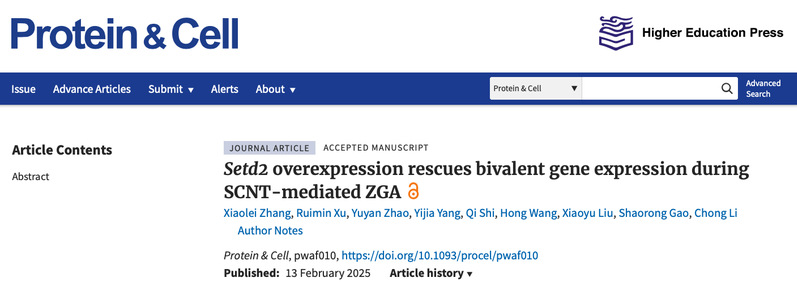
Recently, the research team led by GAO Shaorong, LI Chong, and LIU Xiaoyu from the School of Life Sciences and Technology at Tongji University published a study titled Setd2 overexpression rescues bivalent gene expression during SCNT-mediated ZGA in Protein & Cell. This study, for the first time, mapped the dynamic histone modification landscape of H3K4me3 and H3K27me3 in mouse SCNT embryos, uncovering aberrant bivalent modifications—characterized by concurrent H3K4me3 and H3K27me3 marks—and the resulting dysregulation of bivalent gene expression. Further investigation revealed that Setd2, a histone H3K36me3 methyltransferase, plays a critical role in orchestrating multiple histone modifications during SCNT embryo development. These findings provide new insights into enhancing SCNT efficiency.
The study sheds light on the hierarchical regulatory network of histone modifications during early SCNT embryo development, offering a novel perspective on the molecular mechanisms underlying low SCNT efficiency.
Dr. ZHANG Xiaolei (currently at the Affiliated Stomatology Hospital of Tongji University) and Dr. XU Ruimin from the School of Life Sciences and Technology are the co-first authors of the paper. Academician GAO Shaorong, Professor LIU Xiaoyu from the School of Life Sciences and Technology, and Associate Researcher LI Chong from the Affiliated Obstetrics and Gynecology Hospital of Tongji University are the co-corresponding authors. This research was supported by the Ministry of Science and Technology, the National Natural Science Foundation of China, the Shanghai Science and Technology Commission, and the Shanghai Municipal Education Commission.
Paper link:
https://academic.oup.com/proteincell/advance-article/doi/10.1093/procel/pwaf010/8011356



