The research team led by Professors Wenqiang Liu and Shaorong Gao from the School of Life Sciences and Technology at Tongji University has made significant progress in improving the development of in vitro fertilization (IVF) embryos. Their findings address a major challenge in assisted reproductive technology (ART), where a substantial proportion of IVF embryos fail to implant or develop properly after implantation.
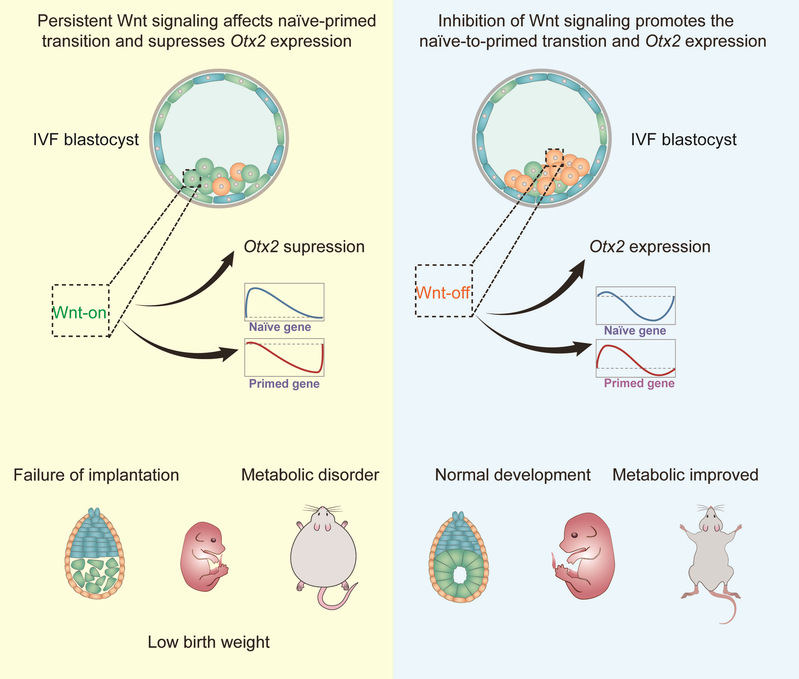
Using a mouse model, the study revealed that while IVF and naturally conceived embryos develop similarly up to the blastocyst stage, IVF embryos exhibit higher rates of implantation failure and subsequent metabolic abnormalities in offspring, including low birth weight and glucose intolerance. The researchers identified aberrant activation of the Wnt signaling pathway as early as the morula stage in IVF embryos. This persistent Wnt signaling disrupts the transition from naïve to primed pluripotency in the epiblast (EPI), a critical step for successful implantation and fetal development.
Advanced 3D in vitro culture systems and single-cell sequencing showed that Wnt overactivation alters histone modifications (H3K27ac and H3K27me3) on pluripotency genes. This leads to delayed naïve-to-primed transition, where IVF embryos retain naïve pluripotency markers while failing to upregulate primed markers. Additionally, the erasure of H3K27me3 on bivalent genes causes premature activation of developmental genes, further impairing embryo organization.
The study demonstrated that treating IVF embryos with the Wnt inhibitor IWP2 at the pre-implantation stage restores normal histone modifications, promotes proper EPI development and rosette formation, and significantly improves implantation rates and offspring health. Notably, this intervention reduced metabolic disorders such as obesity and glucose intolerance in offspring.
Preliminary experiments on human embryos indicated that Wnt inhibition enhances peri-implantation development and facilitates the exit from naïve pluripotency, suggesting potential clinical applications for improving IVF success rates.
This study reveals that persistent Wnt signaling disrupts embryo implantation in IVF by altering histone modifications (H3K27ac/H3K27me3), blocking the naïve-to-primed pluripotency transition and suppressing key genes like Otx2. Treating embryos with the Wnt inhibitor IWP2 restores normal development, improves implantation rates, and prevents metabolic disorders in offspring. The findings offer a promising strategy to enhance IVF success and offspring health, with early human embryo experiments showing similar benefits. Targeting Wnt signaling could transform fertility treatments.
Dr. Yanping Jia, Dr. Yingdong Liu, Associate Professor Yanhe Li, and Dr. Xiaohong Guan from Tongji University are the co-first authors of the paper. Professors Wenqiang Liu, Shaorong Gao (Academician of CAS), and Kunming Li serve as the co-corresponding authors. The study was supported by the National Key R&D Program of China, the National Natural Science Foundation of China (NSFC), and the China Postdoctoral Science Foundation.
Paper link: https://doi.org/10.1016/j.scib.2025.05.003



